A short history of Carcassonne
Romans, Visigoths, Cathars and a 19th-century architect: how a hilltop town became a UNESCO walled city.
In short
People have lived on this hill for about 2,500 years. The Romans built the first walls. The Trencavel family built the castle around 1130 and lost everything in the crusade of 1209. French kings added the second wall. After 1659 the city lost its purpose and began to fall apart, until Viollet-le-Duc began restoring it in 1853. UNESCO listed it in 1997.
Key facts
- First settlement here
- About 550 BC
- Fall of the city
- 15 August 1209
- Viollet-le-Duc begins
- 1853
- UNESCO World Heritage
- 1997
When you walk through Carcassonne's walls, you're looking at about 2,500 years of work. Some of it is Roman, some of it is royal and some of it was built in the age of steam. Knowing which is which is half the pleasure.
Before the walls
People were already living nearby around 800 BC, at a site about 2 km to the south-west. By about 550 BC a village had grown into a hilltop fort, the oppidum of Carcaso. It stood on a good spot, on the route between the Mediterranean and the Atlantic, with the Pyrenees to the south.
The Romans took it in 122 BC. As the empire weakened in the 3rd and 4th centuries, they built the first real wall, about 1,200 metres around, with towers shaped like horseshoes. Seventeen of those towers survive in the inner wall today. Look for their small stones and bands of red brick.
After Rome, the city changed hands several times. Visigoths ruled it from the 5th century. Umayyad forces occupied it in 725, and the Franks attacked it in 759.
The Trencavels and the Cathars
In 1067 the Trencavel family took over as viscounts of Carcassonne. Around 1130 they built a palace on the western side of the city, the beginnings of today's Château Comtal, while the Basilica of Saint-Nazaire, begun in 1096, was going up nearby.
The Trencavels ruled in a region where Catharism had taken hold, a Christian movement that the Pope considered heresy. In 1209 he launched a crusade. The army of crusaders besieged Carcassonne that August, and the city fell on 15 August after its water ran short. The young viscount, Raymond-Roger Trencavel, went to negotiate and was taken prisoner. He died in the castle's own dungeon about three months later.
The land went to the crusade's military leader, Simon de Montfort, and in 1226 the city became part of the French royal domain. A last Trencavel attempt to win it back failed in 1240. Louis IX ordered the rebels' houses to be razed, and the people who lost them were later allowed to build a new town across the Aude. That's the Bastide Saint-Louis, the lower town you walk through from the station.
A royal fortress
Carcassonne now sat on the border between France and Aragon, so the kings of France made it stronger. In the 13th century, under Louis IX and his successors, they built the second, outer wall, about 1,600 metres long. Philip III built the Narbonne Gate around 1280. The two rings of wall made the city almost impossible to take.
It worked. For the next few centuries, Carcassonne was one of the strongest places in the kingdom. That changed in 1659, when the Treaty of the Pyrenees moved the border far to the south. A fortress with no frontier had no purpose.
Decline and rescue
For the next two centuries, the Cité slowly fell apart. Napoleon removed it from the list of the state's strongholds in 1804, and locals carted off the stones for building. Plans were drawn up to demolish what remained.
A local historian, Jean-Pierre Cros-Mayrevieille, spent decades fighting for it. In 1835 he protested against the looting of the stones and began excavating. In 1840 he got the basilica listed as a historic monument, and the inspector Prosper Mérimée came to see the site.
In 1853, Napoleon III approved a restoration project under the architect Eugène Viollet-le-Duc. He worked on Carcassonne until his death in 1879, and his pupil Paul Boeswillwald carried on. The work was finished in 1911.
The great argument
Viollet-le-Duc didn't simply repair what was there. He imagined how the city should have looked and built that. The most famous argument is about the roofs. He gave the towers steep slate cones, like those in northern France, although the local tradition was shallow roofs of red tile. He also added a drawbridge at the Narbonne Gate that had never existed.
Critics have complained about this for more than a century. But UNESCO listed the Cité in 1997, citing both its medieval walls and its restoration. Without Viollet-le-Duc, there would probably be nothing to argue about at all. Today, about three million people visit Carcassonne every year, and a small number of people still live inside the walls.
Where you see this today
- Inner wall: Roman towers with bands of red brick.
- Outer wall: the 13th-century royal fortifications.
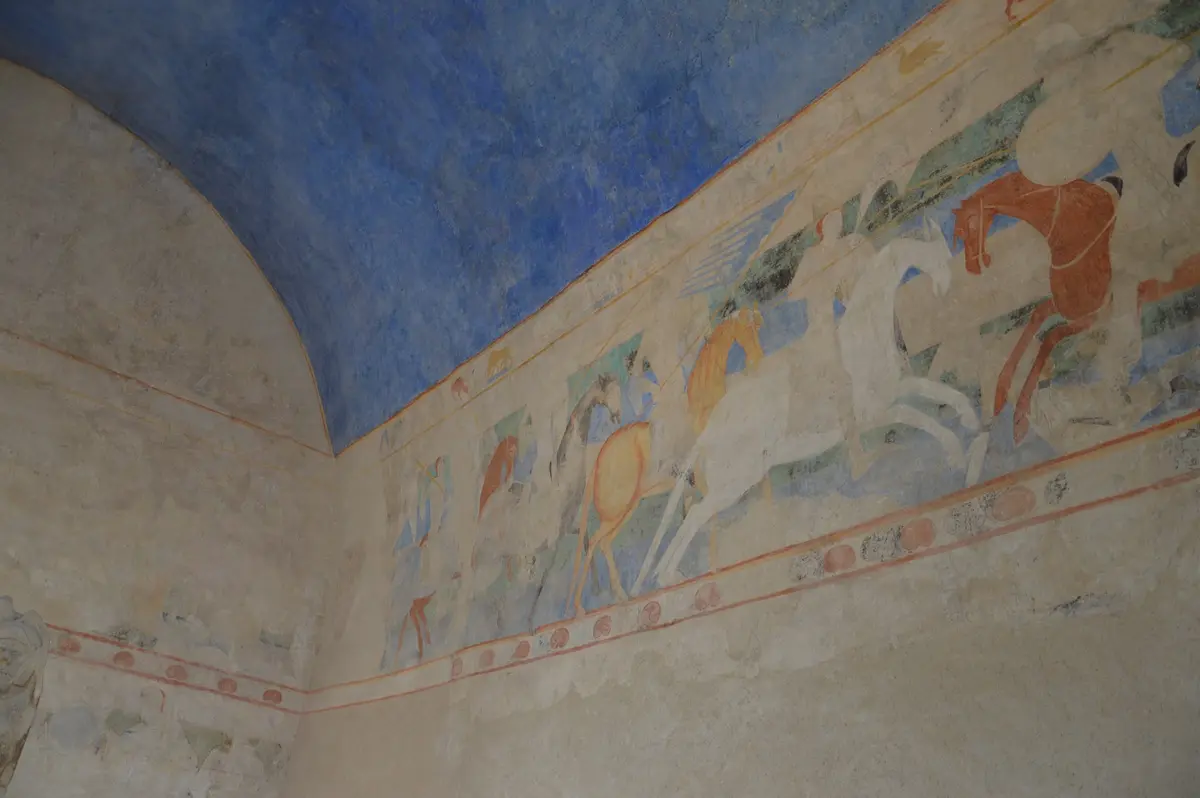
- Château Comtal: the Trencavel palace, with its painted room and later royal changes.
- Roofs and drawbridge: Viollet-le-Duc's 19th-century contribution.
Once you can tell them apart, the walls stop being scenery and start telling a story.
Before you go
- On the inner wall, look for the small Roman stones with bands of brick.
- In the castle, find the painted room with its medieval knights.
- On the Narbonne Gate, remember the drawbridge is a 19th-century addition.
- Compare the slate roofs with the red tiles of the lower town.
Prefer it all arranged?
Guided castle tour: the Cité, the lices and the Château Comtal
More guides

Getting to Carcassonne from Toulouse by train
Which train to take, how long it takes, and the best way from the station up to the walled city.
Last reviewed on 6 November 2026
The best time to visit Carcassonne
Heat, crowds, castle prices and evening light: what each season brings to the walled city.
Last reviewed on 6 November 2026
What to see inside the walls
What's free, what's ticketed, and how to spend a day in the Cité without just following the crowd.
Last reviewed on 6 November 2026